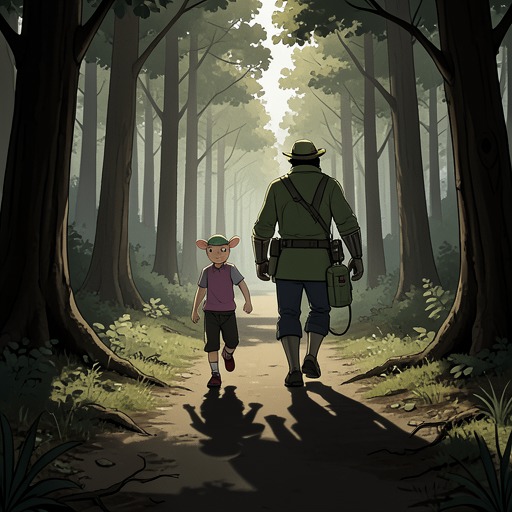
Shasta and Bree’s escape from Calormen
The Horse and His BoyShasta and Bree’s escape from Calormen is the decisive first step in their shared journey from captivity toward the North. Shasta leaves the household where he has been made to work under Arsheesh’s authority; Bree, a Talking Horse stolen as a foal and forced to conceal his nature, risks escape from human ownership. Their departure is an act of mutual aid: Bree needs a rider to avoid being dismissed as a stray, while Shasta needs a horse to outrun pursuit. Together they cross the ridge that had marked the edge of Shasta’s world and set out for Narnia.
Captivity and the Decision to Flee
Shasta’s life with Arsheesh is governed by labor and the threat of punishment. He mends and washes the fishing nets, cooks supper, and cleans their cottage; when Arsheesh sells fish badly, he finds fault with the boy and may beat him. The arrangement is presented as a father-and-son household, but its daily terms leave Shasta little freedom. His longing points not toward the village to the south, which he knows as dull and familiar, but northward, beyond the grassy slope and ridge he has never been permitted to cross.
Bree’s captivity has a different beginning. Stolen or captured while still a foal, he had disobeyed his mother’s warning not to range the southern slopes, into Archenland and beyond. He has spent years enslaved to humans, hiding that he can speak and pretending to be an ordinary, witless horse. Concealment is his means of preserving a chance to escape: if his captors discovered his true nature, he fears they would exhibit him at fairs and guard him more closely. Although his master, the Tarkaan Anradin, does not treat him as badly as a costly war horse might be treated, Bree warns Shasta that being sent to serve in the Tarkaan’s household would be worse than death.
That warning makes flight urgent, but Bree proposes more than a separate escape. If he ran away alone, people would call him a stray horse and pursue him; with a rider, he could pass as a horse with an owner. Shasta, meanwhile, could not travel far on foot without being overtaken, but on Bree he could outdistance other horses in the country. Each becomes the other’s practical means of escape, and their partnership begins in the recognition that neither can safely flee alone.
The Night Departure
Before leaving, Shasta returns to the cottage to discover whether he can go without waking Arsheesh. In the dark, with the sea audible on the beach and no light in the cottage, he hears the fisherman’s familiar squeaky snore through the window. The thought that he may never hear it again makes him feel a little sorry, but his gladness is greater. He retrieves Bree’s saddle and bridle from the donkey’s stable, where the key has been hidden, and pauses to kiss the donkey’s nose, apologizing that it cannot come with them. His departure thus includes a quiet farewell to the only home he has known and to an animal left behind.
Bree begins the journey cautiously rather than galloping straight away. He goes south of the cottage to a little river running into the sea, leaves clear hoof-marks in the mud pointing south, and then changes direction in the middle of the ford. He wades upstream until they are about a hundred yards inland of the cottage, crosses out on a gravelly bank that will take no footprints, and proceeds north at a walk. The false trail and footprint-free crossing show that their escape depends not only on speed but on misleading anyone who might follow.
They climb to the ridge in the gray summer-night darkness. As they continue, the cottage, the tree, the donkey’s stable, and the creek—all the landmarks of Shasta’s familiar life—sink out of sight. On the other side lies open grassland that seems endless, wild, lonely, and free. The physical crossing makes visible the change in Shasta’s circumstances: the boundary he had watched from home is now behind him, and the unknown North has become a path he is actually taking.
A Shared Route North
Once they are away from the cottage, Bree teaches Shasta how to ride. Shasta first finds the horse an alarming height and makes an unsuccessful attempt to mount; Bree jokes that he is climbing as though the horse were a haystack. He instructs Shasta to grip with his knees, keep his eyes ahead between Bree’s ears, and sit straighter if he fears falling. The lesson turns the escape into a working partnership: Bree supplies the horse’s knowledge and strength, while Shasta must learn how to travel with him.
Bree gives their departure a destination and a rallying cry: “for Narnia and the North.” The direction answers Shasta’s childhood fascination with the country beyond the ridge, while also naming Bree’s own lost home. Bree remembers Narnia as a happy land of mountains, downs, rivers, forests, and Dwarfs, and says that an hour there would be better than a thousand years in Calormen. The contrast makes the escape more than a flight from immediate danger: for Bree, it is also an attempt to return to a home from which he was taken as a foal.
Their need for food soon raises the question of whether they may use money taken from their captors. Bree initially has not considered whether doing so would be theft, but reasons that they are prisoners and captives in enemy country and that the money counts as booty or spoil. It is also necessary to buy food for Shasta, who cannot live on the grass and oats that Bree can eat. Even after reaching the open road, the practical conditions of escape remain shaped by their different bodies and needs.
Freedom and Its Cost
The escape also exposes the social contempt that Calormen directs at free peoples. Later, Rabadash argues that Narnia is small enough to conquer with a thousand spears in five weeks and describes it as an unseemly blot on the empire. The Tisroc likewise dismisses countries that call themselves free as idle, disordered, and unprofitable. Against this imperial language, Bree and Shasta’s departure gives freedom a concrete meaning: the ability to leave a master, choose a direction, and move without permission. Their flight begins as a private escape but points toward the larger conflict between Calormen’s power and the independence of Narnia and Archenland.
Bree’s sense of what it means to be free is tested after the party encounters danger on the road. He later declares that he will return to Calormen because he believes himself fit only for slavery: he is ashamed that, while fleeing the lions, he left a mare and a girl to be eaten and ran to save himself. Hwin answers that everyone ran as hard as they could, but Bree sets his conduct against Shasta’s, who ran back in the right direction. The reversal gives their initial escape a moral dimension: Bree had used Shasta as the rider who made flight possible, yet later measures himself against the boy’s courage. Freedom, in Bree’s account, cannot be secured merely by getting away from a master; it also demands an answer to how one acts when others are in danger.
Significance
The departure establishes the story’s central contrast between being treated as property and choosing one’s own course. Shasta’s household labor and Bree’s enforced silence are not identical forms of subjection, but each confines its subject; each also makes the North a possibility of release. Their escape depends on specific acts of cooperation—the hidden stable key, the river crossing, the false southward hoofprints, and the lessons in riding—rather than on an abstract wish for freedom alone.
The ridge crossing is both a geographical departure and a narrative threshold. For Shasta, the open country beyond it overturns the limits of what he has seen and been allowed to do. For Bree, the journey turns away from years of hiding toward the land he remembers as home. Their first night on the road therefore begins two connected quests: a boy’s passage beyond an imposed life and a stolen horse’s attempt to recover the freedom and belonging taken from him.